Translate

Tuesday, January 6, 2015

Programming your mind for success

 Carrie Green on TEDxManchester:

Success is not an accident! Living an incredible life is not accident, you have to do it on purpose. Know exactly what you want to achieve, know why you want to achieve it, know the kind of person you need to become in order to make it happen, so program your mind to make it happen..

Because you just have only one life to achieve everything you want to aciheve, so you have to act accordingly!


Monday, January 5, 2015

How To Overcome Fear of Failure and Judgment. Как преодолеть страх осуждения.

Любая неудача может не только парализовать, но и мобилизовать на дальнейший успех!

Помните, что если продукт, который вы предлагаете, не нравится окружающим, то для этого есть всего три причины:

1) Вы предлагаете хрень.

2) Вы хреново предлагаете.

3) Вы предлагаете не тем людям!

Не опускайте руки, если вас осуждают. Не бойтесь выслушивать критику и чужие мнения. Сделайте из этого нужные вам выводы и двигайтесь дальше!


Executing Your Idea Starts With a Small Single Step. Исполнение идеи начинается с маленького шага!

У вас идея, которая не даёт вам покоя даже в душе, от которой мурашки по коже, которая не даёт вам спать? Запишите её! Представьте! Визуализируйте! Рисуйте её! Для этого вовсе не обязательно быть художником, поверьте!

Исполнение вашей идеи начинается с одного небольшого шага

Joe Gebbia: Executing Your Idea Starts With a Small Single Step

We all have that idea that we can't shake out of our head, the one that we think about in the shower or daydream about. Entrepreneur Job Gebbia, shares how his team grew their idea, Airbnb, into a national startup the hard way: by staying lean, "doing things that don't scale" like meeting users one at a time, and by taking one small step at a time.

Joe leads us in a storyboarding exercise that helped his team take ideas and push them into reality.

About Joe Gebbia

Joe defines the Airbnb experience. He is dedicated to creating an inspiring and effortless user experience through sharp, intuitive design, and crafts the product roadmap to make it so. Joe values products that simplify life and have a positive impact on the environment, and ensures that the company adheres to these tenets 

Prior to Airbnb, Joe was employed by Chronicle Books, co-founded Ecolet, a green design website, and developed several consumer products, including CritBuns, a product featured in the Cooper Hewitt Design Triennial. An alumnus of the Rhode Island School of Design, Joe earned dual degrees in Graphic Design and Industrial Design.


Imagination changes everything! Фантазия - двигатель мечты!

Воображение меняет всё!

Мечта так и останется мечтой, если её не видеть в движении!
Визуализировать свою цель = добиться осуществления своей мечты.
При сильном желании можно сделать из хлама подобие скрипки и заставить его играть!

Patti Dobrowolski, author of DRAWING SOLUTIONS: How Visual Goal Setting Will Change Your Life is the founder of Up Your Creative Genius, a consulting firm that uses visuals and creative processes to help companies and individuals around the world accelerate growth and change. A critically acclaimed comic performer, internationally recognized keynote speaker, writer and business consultant, she has brought her innovative visual practices to NGOs, Fortune 500 companies, small businesses and individuals around the world.

Sunday, January 4, 2015

Хотите узнать цель своей жизни за 5 минут? / How to know the life purpose in 5 minutes

На встрече одноклассников через 20+ лет выясняется, что 80% присутствующих недовольны своей жизнью.


Adam Leipzig has overseen more than 25 movies as a producer, executive and distributor. and has produced more than 300 stage plays and live events, and he was one of the founders of the Los Angeles Theatre Center.
AdamLeipzig.com


О чём вам говорит ваша креативность? / What creativity is trying to tell you?


What creativity is trying to tell you: Jonathan Tilley at TEDxStuttgart

The creative process is as individual as it is universal. And yet there is a secret that creativity itself is yearning to tell us. Since the age of 9, Jonathan has performed as a singer, dancer, actor, and gone on to other creative ventures such as a playwright, director, choreographer, author, and voice over artist. Many different titles, one common thread: Creativity. He shares pivotal life experiences that define creativity for him and shows how you can tap into your own creativity on a daily basis, in whatever space and time you have.

Saturday, January 3, 2015

Life is good!


Do What You Like, Like What You Do: Bert Jacobs at TEDxBeaconStreet

Cоздатель компании Life is good!


Смех не имеет иностранных акцентов!

Bert discusses why Life is good, a positive lifestyle brand, purposely blurs the lines between work, play, for-proft enterprise and non-profit social work. The lessons learned from his personal and professional experiences illustrate that the keys to a happy and fulfilling life are all around us.

"Настоящие новаторы и предприниматели видят себя создателями квилтов!" A crash course in creativity

Источники креативности:


"True innovators, true entrepreneurs see themselves as quilt makers!"

See more in this course! Amazing talk about opening your creativity!

Уж если мечтать, то ни в чём себе не отказывать!

Creative thinking - how to get out of the box and generate ideas: Giovan...

This video is filmed and edited by Università Telematica Internazionale UNINETTUNO www.uninettunouniversity.net.
Corazza is a full-time professor at the Alma Mater Studiorum at the University of Bologna, a member of the Executive Council, and the founder of the Marconi Institute of Creativity. He teaches science and the applications of creative thinking. Why/Which/How/Where/What/When/Experiment­. A quick jump out of the box is more insight ful than a lifetime of standard thinking. 

In the spirit of ideas worth spreading, TEDx is a program of local, self-organized events that bring people together to share a TED-like experience. At a TEDx event, TEDTalks video and live speakers combine to spark deep discussion and connection in a small group. These local, self-organized events are branded TEDx, where x = independently organized TED event. The TED Conference provides general guidance for the TEDx program, but individual TEDx events are self-organized.* (*Subject to certain rules and regulations)

Friday, January 2, 2015

10 Правил творчества (из книги Austin Kleon "Steal like an artist")

Манифест о жизни, работе, интернете, общении и творчестве.

Остин Клеон, художник и поэт, автор сборника Newspaper Blackout Poems, сформулировал правила эффективного творчества, которые мгновенно его прославили. Вы не пожалеете, что прочитали эту статью.

Кради как художник

Каждому приходится отвечать на вопрос, откуда он берет свои идеи. Честный художник ответит: «Я ворую их». Вот и все, что можно об этом сказать. Это понимает каждый творческий человек.

Ничто не оригинально на 100%

Есть 3 слова, которые вселяют в меня надежду всякий раз, когда я их читаю.
Нет ничего оригинального на 100%. Об этом было сказано еще в Библии: «Что было, то и будет; и что делалось, то и будет делаться, и нет ничего нового под солнцем» (Экк 1:9). В любом новом проекте смешаны элементы старых идей или просто изменяется одна из них.

1+1=3

В художественных школах всегда показывают один трюк. Нарисуйте на листе бумаги две параллельные линии:
Сколько линий на рисунке? Видна первая линия, вторая, но есть ещё и темная линия между ними. Видите?
1 + 1 = 3.

Вы нечто большее

Есть еще один хороший пример того, о чем я говорю — в генетике. Вы наследуете гены своих отца и матери, но при этом не являетесь только набором родительских черт. Вы — нечто большее, новая версия и родителей и всех своих многочисленных предков.

Происхождение идей

Вы не можете выбирать родителей, но можете выбирать учителей, друзей, музыку, книги и фильмы.
На самом деле, ты — это то, что ты впускаешь в свою жизнь. Ты — сумма того, что на тебя влияет. Как говорил Гете, «нас создает и формирует то, что мы любим».

Творчество — это коллекционирование

Художник — это коллекционер. Не скупердяй, который собирает все без разбора, а именно коллекционер — который целенаправленно собирает только те вещи, которые действительно любит.
Есть одна экономическая теория — если сложить доход своих пяти ближайших друзей и найти среднее арифметическое, результат окажется очень близким к собственному доходу.
Думаю, то же самое относится и к идейному доходу. Мы настолько же круты, насколько круто наше окружение.

Мусор на входе — мусор на выходе

Моя мама любила повторять мне: «Мусор на входе — мусор на выходе». Это сводило меня с ума. Но теперь я понимаю, что она имела в виду. Ваша задача — собирать лучшие идеи. Лучший способ для этого — читать. Читать, читать, читать, читать, читать. Газеты, погоду, дорожные знаки, лица незнакомцев. Чем больше вы читаете, тем шире выбор того, что повлияет на вас.
Выберите писателя, который вам действительно нравится. Найдите все его произведения. Узнайте, что он сам читал. И прочитайте все это. Взбирайтесь по своему генеалогическому дереву писателей.
Крадите идеи и сохраняйте их на будущее. Носите всюду записную книжку. Пишите в книгах. Вырывайте страницы из журналов и создавайте из них коллажи в своем скрапбуке. Крадите, как художник.

Чтобы начать действовать, не нужно ждать

Прочитайте и задумайтесь — «Если вы не знаете, кто вы и для чего живете или во что верите, практически невозможно заниматься творчеством».
Если бы я ждал, когда пойму «кто я» и «для чего живу» до того, как стал «заниматься творчеством», я до сих пор сидел бы без дела, пытаясь найти себя, вместо того, чтобы просто начать что-то делать. По собственному опыту знаю — именно в процессе работы мы понимаем кто мы.

Делать = Знать

Вы уже готовы. Начинайте делать. Возможно, вы напуганы. Это естественно. Есть одна особенность, которая свойственна прежде всего образованным людям. Она называется «синдромом самозванца». Согласно медицинскому описанию, это «психологический феномен, при котором человек не способен адекватно принимать собственные успехи». Он чувствует себя обманщиком, который все делает наугад, а на самом деле даже не понимает, чем занимается.
И знаете что? Никто не понимает. Когда я начал вычеркивать слова из газетных колонок, я не имел ни малейшего понятия о том, что делаю. Я знал только, что это здорово. Это казалось не работой, а игрой. Спросите любого хорошего художника, и он скажет правду — он не знает, откуда берутся шедевры. Он просто делает свое дело. Каждый день.

Притворяйтесь, пока не начнет получаться

Притворяйтесь, пока не начнет получаться. Мне нравится эта фраза. Ее можно понимать двояко: притворяйся, пока не достигнешь успеха, пока все не увидят тебя таким, каким ты хочешь. Или — притворяйся, пока действительно не научишься что-то делать. Мне очень нравится эта мысль.
Еще мне нравится книга Патти Смит Just Kids. Это история о том, как два друга приехали в Нью-Йорк, чтобы научиться быть художниками. Знаете, как они это делали? Они вели себя как художники. Мой любимый, ключевой, сюжет книги — Патти Смит и ее друг Роберт Мэплторп, одевшись как бродяги, отправились в Вашингтон-Сквер, где всегда много народа. Одна старушка уставилась на них и сказала мужу: «Сфотографируй их. Думаю, они художники». «Нет, — он покачал головой, — они просто дети».
Весь мир — это сцена. Для творчества вам тоже нужна сцена, костюм и сценарий. Сцена — это ваше рабочее пространство. Это может быть студия, письменный стол или альбом для набросков. Костюм — это ваша рабочая одежда — специальные штаны, в которых вы рисуете, домашние тапочки, в которых пишете, или та забавная шляпа, что вдохновляет вас. А сценарий — это время. Час здесь, час там. Сценарий в пьесе — это только время, отведенное на разные эпизоды.
Притворяйтесь, пока не начнет получаться.

Напишите книгу, которую сами хотели бы прочитать

Расскажу короткую историю. «Парк Юрского периода» вышел в прокат, когда мне было 10 лет. Я бредил этим фильмом — как и всякий 10-летний ребенок. В тот момент, когда я выходил из кинотеатра своего провинциального городка, я уже ждал продолжения.
На следующий день я сел за свой старый компьютер с зеленым монитором и сам написал продолжение. В нем сын лесника, съеденный в первом фильме велоцирапторами, возвращается на остров вместе с внучкой создателя парка. Он хочет разрушить парк окончательно, она — сохранить его. С ними случаются разные приключения, и в результате они, конечно, влюбляются друг в друга.
Тогда я не знал, что написал то, что сейчас называется фан-фикшн — выдуманными историями с уже существующими персонажами. Я сохранил тогда свою историю на компьютере. А через несколько лет вышел «Парк Юрского периода-2». И его сюжет был высосан из пальца. Сиквел фильма никогда не может сравниться с продолжением, которое мы уже создали в своей голове.

Пишите не о том, что знаете, а о том что нравится

Начинающий писатель всегда задается вопросом, о чем ему стоит писать. Обычно ему говорят: «Пиши о том, что хорошо знаешь». В результате часто получаются ужасные истории, в которых не происходит ничего интересного. Поэтому лучший совет — не писать о чем знаешь, а писать о чем хочешь. Напишите такую историю, которая нравится вам самим. Мы занимаемся творчеством, поскольку нам это по душе. Вся художественная литература — это, по сути, фан-фикшн. Лучший способ решить, чем заняться — это подумать о том, чего бы вам хотелось достичь, что ещё не сделано, и потом сделайте это. Создавайте картины, на которые вы сами хотели бы смотреть, музыку, которую хотели бы слушать, пишите книги, которые хотели бы прочитать.

Пользуйтесь руками

Мой любимый мультипликатор Линда Барри однажды сказала: «Ваши руки — это самый первый цифровой девайс». Когда я учился писательскому мастерству в колледже, мне приходилось, как и всем, сдавать свои сочинения, набранными через двойной интервал шрифтом Times New Roman. И у меня все выходило ужасно. Стоило мне только начать писать от руки, как работа пошла веселее, и ее качество заметно улучшилось.
Чем дальше я держусь от компьютера, тем лучше становятся мои идеи. Microsoft Word — это мой враг. Я все время пользуюсь им на работе, поэтому в остальное время стараюсь с ним не связываться.
Думаю, что чем больше писательство становится физическим процессом, тем лучше получаются произведения. Можно почувствовать чернила на бумаге. Можно разложить листы по всему столу и перебирать их. Можно положить текст везде, где на него будет удобно смотреть.
Есть некое волшебство в том, чтобы держать в руке печатный лист. В творческий процесс вовлекаются многие из чувств — даже запахи могут подарить совершенно особенный опыт.
Искусство, которое идет только от головы, ничем хорошим быть не может. Посмотрите на любого талантливого музыканта, и вы поймете, о чем я. Когда я составляю стихи, я не чувствую, что это работа. Это как игра. Мой совет: найдите способ вовлечь свое тело в работу. Рисуйте на стенах. Стойте во время работы. Раскладывайте вещи на столе. Пользуйтесь руками.

Сторонние проекты и хобби — важная вещь

Главная вещь, которую я понял в то недолгое время, что я был художником: именно сторонние проекты «выстреливают».
Под ними я подразумеваю те вещи, которые сначала казались незначительными. Просто игрой. Однако как раз эти вещи действительно стоящие — именно в них заключается волшебство. Например, если бы я занимался только написанием коротких рассказов, если бы не давал себе свободно экспериментировать, я бы никогда не стал тем, кто я сейчас.
Итак, совет таков: выделите себе время на безделье. Найдите хобби. Это пойдет на пользу, и вы никогда не знаете, куда приведет вас ваше увлечение.

Делайте что-то хорошее и размещайте там, где люди увидят это

Я получаю много писем от молодых художников, которые спрашивают, как им найти своего зрителя. «Как сделать так, чтобы меня кто-то открыл»? Я очень хорошо их понимаю. После окончания колледжа я тоже был в некоторой растерянности. Учебный класс — это прекрасное, хотя и искусственно созданное для творчества место — профессору платят за то, что он занимается твоими идеями, а твои сокурсники платят за то, чтобы интересоваться ими.
Никогда в жизни у вас больше не будет таких внимательных зрителей. Однако вскоре вы узнаете, что миру в целом нет дела до ваших идей. Это звучит жестко, но это так. Как сказал Стивен Прессфилд, «это не значит, что люди необразованны или жестоки, они просто заняты». Если бы существовала какая-то секретная формула завоевывания аудитории, я бы рассказал вам ее. Но я знаю только одну не такую уж оригинальную формулу: «Сделайте хороший проект и поместите туда, где люди смогут его увидеть».
Этот процесс проходит в 2 этапа:
Шаг 1: «Сделайте хороший проект» — невероятно сложен. И здесь нет рецепта быстрого успеха. Занимайтесь своей идеей каждый день. Терпите неудачи, делайте лучше.
Шаг 2: «Сделайте так, чтобы проект увидели» — был сложным только 10 лет назад. Теперь же все очень просто — «поместите проект в интернет».
Вы должны удивляться вещам, которым никто, кроме вас, не удивляется. Если кто-то находит удивительными яблоки, удивляйтесь апельсинам. Одна из тех вещей, которым я научился будучи художником, — чем более открыто ты делишься своими чувствами, тем больше людям нравится твое искусство. Художники — не фокусники. За раскрытие своих секретов не последует никакого наказания.
Людям нравится, когда ты раскрываешь секреты, и иногда, если у тебя это хорошо получается, они покупают то, что ты продаешь.
Когда ты открываешься и вовлекаешь людей в творческий процесс, ты сам учишься. Найдите людей, которые любят те же вещи, что и вы, и общайтесь с ними. Делитесь с ними идеями.

География больше не управляет нами

Я счастлив, что живу именно сейчас.
Я вырос посреди кукурузных полей в южном Огайо. Когда я был ребенком, единственное, что я хотел, — это попасть в компанию к художникам. Вырваться из южного Огайо и очутиться там, где что-то происходит.
Сейчас я живу в Остине, в Техасе. В целом, классное место. Повсюду масса художников и других творческих людей.
И знаете что? 90% моих наставников и коллег не живут в Остине. Они живут в интернете. Большая часть моих проектов, разговоров и творческих знакомств происходят в сети. Вместо реального общения в художественных студиях я завел приятелей в твиттере и Google Reader.
Вся жизнь случайна.

Будьте хорошим человеком (потому что мир тесен)

Скажу об этом вкратце. Это единственная причина, почему я здесь — для того чтобы найти новых друзей.
Курт Воннегут сказал об этом намного лучше: «Я знаю только одно правило: нужно быть добрым, черт возьми». Золотое правило стало еще более ценным в нашем таком тесном мире. Важный урок: если вы говорите о ком-то в интернете, он это обнаружит. Все набирают свое имя в гугл-поиске. Лучший способ победить врагов в интернете — игнорировать их. Лучший способ приобрести друзей — говорить о них хорошо.

Будьте скучными (это единственный способ что-то сделать)

Как сказал Флобер: «Нужно быть правильным и последовательным в повседневной жизни — это позволит быть страстным и оригинальным в работе». Я скучный парень, работающий с 9 до 17, и живущий в тихом районе вместе с женой и собакой.
Весь этот романтический образ богемного художника, который употребляет наркотики, слоняется без дела и спит со всеми подряд, — полностью выдуман. Он предназначен для сверхчеловека или для того, кто хочет умереть молодым. Правда в том, что искусство требует много энергии. А энергии не будет, если тратить ее на посторонние вещи.
Вот несколько советов, которые принесли пользу лично мне:
— берегите себя;
— завтракайте, делайте пару подтягиваний, нормально спите. Помните, что я говорил раньше о том, что хорошее искусство идет из тела?
— не берите в долг;
— живите просто. Экономьте на каждой копейке. Свобода от финансовых стрессов означает свободу в искусстве;
— найдите дневную работу и держитесь за нее. Такая работа приносит деньги, связь с миром и рутинным распорядком. Закон Паркинсона гласит: работа заставляет лучше распределять время. Я работаю с 9 до 17 и занимаюсь творчеством ровно столько же, сколько занимался, работая по полдня.
— заведите календарь и дневник. Вам нужен список предстоящих и прошедших событий. Искусство требует постепенной работы. Совсем несложно написать страницу в день. Делайте это 365 дней в году, и у вас получится большая повесть. Календарь поможет вам планировать работу. Вот календарь , который я использовал, когда писал книгу.
Заводите календарь для любой цели. Разбейте выполнение задачи на маленькие промежутки времени. Превратите это в игру.
Для прошедших событий я предлагаю вести дневник. Это не регулярный журнал, а просто маленькая книжечка, в которую нужно заносить все, что вы делаете каждый день. Вы поразитесь тому, насколько полезным может быть такое ежедневное записывание, особенно через несколько лет.
Создайте крепкую семью. Это самое важное, что вам придется сделать. Хороший супруг будет не только вашим партнером, но и коллегой, другом, тем, кто всегда рядом.

Творчество — это отказ от ненужного

Часто художник бросает именно то, что в итоге делает его искусство интересным. В наш век информационного изобилия успеха добьются те, кто поймут, что нужно отбросить, чтобы сосредоточиться на том, что для них действительно важно. Посвящение себя чему-то означает отказ от других вещей. Это верно и в отношении искусства.
Творчество — это не только вещи, которые мы решаем включить, но и те, что мы исключаем. Или вычеркиваем. Вот, пожалуй, и все, что я могу сказать.
Перевод Елены Демидовой
Источник: theoryandpractice


Источник: http://www.adme.ru/tvorchestvo-reklama/10-pravil-tvorchestva-292855/ © AdMe.ru

Cash is born!

Couple minutes ago the little baby-boy Cash was born! Congratulations, Aby and Nate!
For their wedding I made Wedding ring quilt as a gift
and promised to make another quilt for their first new-born.
Here it is! I used leftover grey and white fabrics from the original quilt and add green background which was also the color of their wedding.

 Not finished quilting yet, but by the time he is big enough to use it I will finish it - promise!

Austin Kleon, Steal like an Artist! (TED video)

This video was filmed at an independently organized TEDx event and uploaded by the organizer.

Watch video here.
Austin Kleon's talk "Steal Like An Artist" is a creative manifesto based on 10 things he wish he'd heard when he was starting out. Austin is a writer and artist. He's the author of Newspaper Blackout, a best-selling book of poetry made by redacting newspaper articles with a permanent marker. Austin's talk was delivered as part of the TEDxKC presentation of TEDxChange. Austin's work (including his new book) "Steal Like An Artist" has been featured on NPR's Morning Edition, PBS Newshour, and in The Wall Street Journal. He speaks about creativity, visual thinking, and being an artist online for organizations such as SXSW and The Economist. AboutTEDx In the spirit of ideas worth spreading, TEDx is a program of local, self-organized events that bring people together to share a TED-like experience. At a TEDx event, TEDTalks video and live speakers combine to spark deep discussion and connection in a small group. These local, self-organized events are branded TEDx, where x = independently organized TED event. The TED Conference provides general guidance for the TEDx program, but individual TEDx events are self-organized.* (*Subject to certain rules and regulations)

Think like a devil, act like an angel (TED video)

This video was filmed at an independently organized TEDx event and uploaded by the organizer.

vil Creativity | Mario Herger | TEDxSalzburg

Watch video here.


This talk was given at a local TEDx event, produced independently of the TED Conferences. Have you ever wondered why villains seem to have always the much cooler toys than the heroes? Why do...
Added Dec 24, 2014

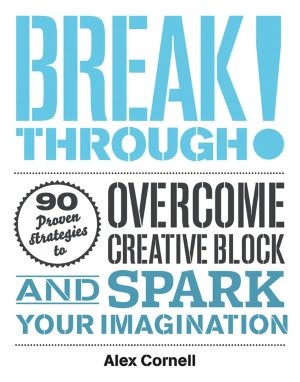
How to Break Through Your Creative Block: Strategies from 90 of Today’s Most Exciting Creators

Refining the machinery of creativity, or what heartbreak and hydraulics have to do with coaxing the muse.

What extraordinary energy we expend, as a culture and a civilization, on trying to understand where good ideas come fromhow creativity works, its secrets, its origins, itsmechanisms, and the five-step action plan for coaxing it into manifestation. And little compares to the anguish that comes with the blockage of creative flow.
In 2010, designer and musician Alex Cornellfound himself stumped by a creative block while trying to write an article about creative block. Deterred neither by the block nor by the irony, he reached out to some of his favorite artists and asked them for their coping strategies in such an event. The response was overwhelming in both volume and depth, inspiring Cornell to put together a collection on the subject. The result is Breakthrough!: 90 Proven Strategies to Overcome Creative Block and Spark Your Imagination (public library) — a small but potent compendium of field-tested, life-approved insight on optimizing the creative process from some of today’s most exciting artists, designers, illustrators, writers, and thinkers. From the many specific strategies — walks in nature, porn, destruction of technology, weeping — a few powerful universals emerge, including the role ofprocrastination, the importance of a gestation period for ideas, and, above all, the reminder that the “creative block” befalls everyone indiscriminately.
Writer Michael Erard teases apart “creative block” and debunks its very premise with an emphasis on creativity as transformation:
First of all, being creative is not summoning stuff ex nihilo. It’s work, plain and simple — adding something to some other thing or transforming something. In the work that I do, as a writer and a metaphor designer, there’s always a way to get something to do something to do something else. No one talks about work block.
Also, block implies a hydraulic metaphor of thinking. Thoughts flow. Difficulty thinking represents impeded flow. This interoperation also suggests a single channel for that flow. A stopped pipe. A dammed river. If you only have one channel, one conduit, then you’re vulnerable to blockage. Trying to solve creative block, I imagine a kind of psyching Roto-Rootering.
My conceptual scheme is more about the temperature of things: I try to find out what’s hot and start there, even if it may be unrelated to what I need to be working on, and most of the time, that heats up other areas too. You can solve a lot with a new conceptual frame.
Designer Sam Potts suggests that heartbreak isn’t merely evolutionary adaptive strategy, it’s a creative one:
Have your heart broken. It worked for Rei Kawakubo. You’ll realize the work you’d been doing wasn’t anywhere near your potential.
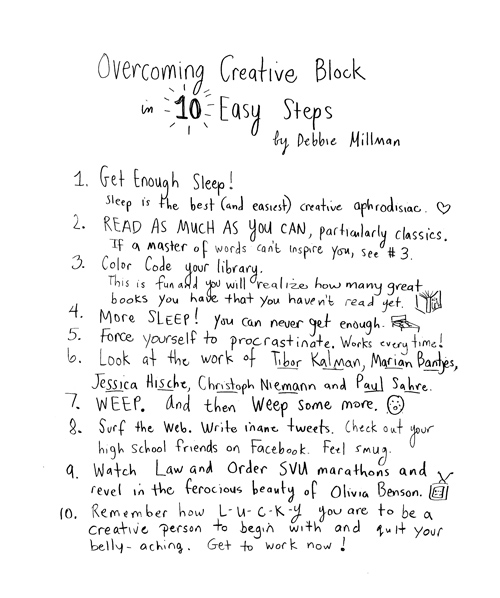
From the inimitable Debbie Millman, who has kindly offered this hand-lettered version of the typeset list in the book:
  1. Get enough sleep! Sleep is the best (and easiest) creative aphrodisiac.
  2. Read as much as you can, particularly classics. If a master of words can’t inspire you, see number 3.
  3. Color code your library. That is fun, and you will realize how many great books you have that you haven’t read yet.
  4. More sleep! You can never get enough.
  5. Force yourself to procrastinate. Works every time!
  6. Look at the work of Tibor Kalman, Marian Bantjes, Jessica Hische, Christoph Niemann, and Paul Sahre.
  7. Weep. And then weep some more.
  8. Surf the Web. Write inane tweets. Check out your high school friends on Facebook. Feel smug.
  9. Watch Law & Order: SVU marathons. Revel in the ferocious beauty of Olivia Benson.
  10. Remember how L-U-C-K-Y you are to be a creative person to begin with and quit your bellyaching. Get to work now!
Illustrator Marc Johns, whose art I have on my arm, offers:
Pretend. Stop thinking like a designer or writer or whatever you are for a minute. Pretend you’re a pastry chef. Pretend you’re an elevator repair contractor. A pilot. A hot dog vendor. How do these people look at the world?
One of my favorite musicians, Alexi Murdoch, extends an infinitely important, infinitely timely contrarian critique of creativity-culture:
Beethoven drank buckets of strong, black coffee. Beethoven was creatively prodigious. (He also went deaf and, perhaps, mad.) Sound syllogism here? I’d like to think so.
The idea that creativity is some abundantly available resource waiting simply for the right application of ingenuity to extract, refine, and pipe it into the grid seems so axiomatic at this cultural juncture that the very distinction between creativity and productivity has been effectively erased.
And so it is that, when faced with a decreased flow in productivity, we ask not what it might be that’s interfering with our creative process, but rather what device might be quickly employed to raise production levels. This is standard, myopic, symptomatology-over-pathology response, typical of a pressurized environment of dislocated self-entitlement.
At the risk of going off brief here, can I just ask: What’s wrong with creative block? Might it not just be that periods — even extended ones — of productive hiatus are essential mechanisms of gestation designed to help us attain higher standards in our pursuit of creative excellence?
Writer Douglas Rushkoff rebels:
I don’t believe in writer’s block.
Yes, there may have been days or even weeks at a time when I have not written — even when I may have wanted to — but that doesn’t mean I was blocked. It simply means I was in the wrong place at the wrong time. Or, as I’d like to argue, exactly the right place at the right time.
The creative process has more than one kind of expression. There’s the part you could show in a movie montage — the furious typing or painting or equation solving where the writer, artist, or mathematician accomplishes the output of the creative task. But then there’s also the part that happens invisibly, under the surface. That’s when the senses are perceiving the world, the mind and heart are thrown into some sort of dissonance, and the soul chooses to respond.
That response doesn’t just come out like vomit after a bad meal. There’s not such thing as pure expression. Rather, because we live in a social world with other people whose perceptual apparatus needs to be penetrated with our ideas, we must formulate, strategize, order, and then articulate. It is that last part that is visible as output or progress, but it only represents, at best, 25 percent of the process.
Real creativity transcends time. If you are not producing work, then chances are you have fallen into the infinite space between the ticks of the clock where reality is created. Don’t let some capitalist taskmaster tell you otherwise — even if he happens to be in your own head.
Musician Jamie Lidell echoes Tchaikovsky:
Cheers. Watcha gonna do with a blocked toilet? I mean, that’s all it is, right? A bung that needs pulling to let the clear waters of inspiration flow.
Maybe. Or maybe it just takes showing up. Going back again and again to write or paint or sing or cook.
Some days the genius will be in you, and you will sail. Other days the lead will line the slippers, and you’ll be staring into the void of your so-called creative mind, feeling like a fraud. It’s all part of the big ole cycle of creativity, and it’s a healthy cycle at that.
As a notorious marginalian, I wholeheartedly second this bit from digital-media artist and data viz wunderkind Aaron Koblin, head of the Data Arts Team in Google’s Creative Lab:
They say an elephant never forgets. Well, you are not an elephant. Take notes, constantly. Save interesting thoughts, quotations, films, technologies…the medium doesn’t matter, so long as it inspires you. When you’re stumped, go to your notes like a wizard to his spellbook. Mash those thoughts together. Extend them in every direction until they meet.
Philosopher Daniel Dennett has a special term for his method:
My strategy for getting myself out of a rut is to sit at my desk reminding myself of what the problem is, reviewing my notes, generally filling my head with the issues and terms, and then I just get up and go do something relatively mindless and repetitive. At our farm in the summer, I paint the barn or mow the hayfield or pick berries or cut fire wood to length…. I don’t even try to think about the problem, but more often than not, at some point in the middle of the not very challenging activity, I’ll find myself mulling it over and coming up with a new slant, a new way of tackling the issue, maybe just a new term to use. Engaging my brain with something else to control and think about helps melt down the blockades that have been preventing me from making progress, freeing up the circuits for some new paths. My strategy could hardly be cruder, but it works so well so often that I have come to rely on it.
One summer, many years ago, my friend Doug Hofstadter was visiting me at my farm, and somebody asked him where I was. He gestured out to the big hayfield behind the house, which I was harrowing for a reseeding. ‘He’s out there on his tractor, doing his tillosophy,’ Doug said. Ever since then, tillosophy has been my term for this process. Try it; if it doesn’t work, at least you’ll end up with a painted room, a mowed lawn, a clean basement.
But as a tireless proponent of combinatorial creativity, my favorite comes from the inimitable Jessica Hagy of indexed fame, who pretty much articulates theBrain Pickings founding philosophy:
How can you defeat the snarling goblins of creative block? With books, of course. Just grab one. It doesn’t matter what sort: science fiction, science fact, pornography (soft, hard, or merely squishy), comic books, textbooks, diaries (of people known or unknown), novels, telephone directories, religious texts — anything and everything will work.
Now, open it to a random page. Stare at a random sentence.
[…]
Every book holds the seed of a thousand stories. Every sentence can trigger an avalanche of ideas. Mix ideas across books: one thought from Aesop and one line from Chomsky, or a fragment from the IKEA catalog melded with a scrap of dialog from Kerouac.
By forcing your mind to connect disparate bits of information, you’ll jump-start your thinking, and you’ll fill in blank after blank with thought after thought. The goblins of creative block have stopped snarling and have been shooed away, you’re dashing down thoughts, and your synapses are clanging away in a symphonic burst of ideas. And if you’re not, whip open another book. Pluck out another sentence. And ponder mash-ups of out-of-context ideas until your mind wanders and you end up in a new place, a place that no one else ever visited.
Marvelous.
At once practical and philosophical, Breakthrough! promises to help you burst through your own creative plateaus. Whether or not it succeeds, one thing it’s guaranteed to do is make you feel less alone in your mental struggles — and what greater reassurance than that could there be?